

Visibility Architecture | May 20, 2026
Diana Stanescu, Director Finance and Capital Markets, Keysight Technologies
In trading, speed is easy to celebrate and hard to explain. A feed can arrive in microseconds, an order can move through the stack in less time than it takes to blink, and still a firm may struggle to answer the most important question when something goes wrong: what happened?
That is the problem hidden inside today’s “invisible infrastructure”. As markets become more data-intensive, fragmented and automated, the competitive question is no longer only how fast data moves, but whether firms can understand the path it takes, prove what happened when challenged and build demonstrable resilience into the trading environment.
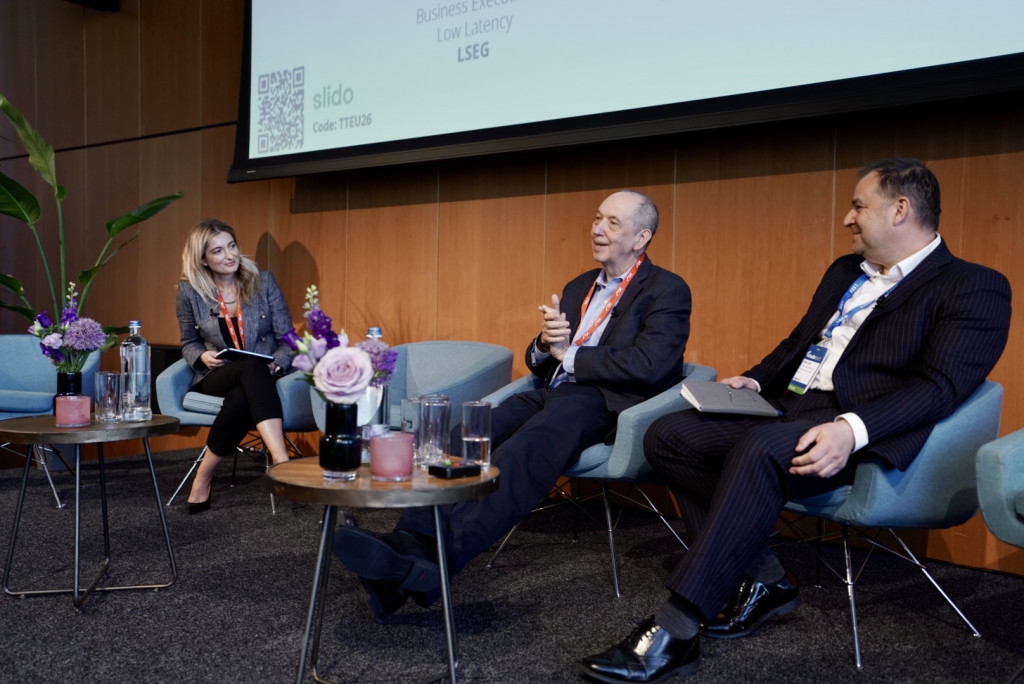
That question shaped a recent TradeTech discussion I participated in with Rob Lane, Global Head of Business Execution, Low Latency Group at LSEG, and Kevin Formby, VP Finance and Capital Markets Solutions at Keysight Technologies.
Market data makes invisible infrastructure visible
One of the clearest places to see this shift is market data. It is no longer just an input into trading, but part of the foundation firms rely on to test strategies, route orders, assess performance and understand how markets are changing.
As firms consume more feeds, from more venues, across more asset classes and regions, both historical and real-time data need to support a wider set of trading, analytics, surveillance and decision-making workflows. Venue upgrades, policy shifts and changes in trading behaviour can alter demand quickly, meaning data capabilities cannot be treated as a fixed estate.
For firms, the challenge is not only delivery speed; it is also timestamping, completeness, venue coverage and the ability to keep pace as exchanges, market structure and client demand change. That is the space LSEG’s Low Latency Group occupies: helping firms work with data they can trust at the point of capture, trade from in real time and return to when questions arise.
Once that data enters the firm’s own environment, it may pass through co-location environments, internal networks, cloud analytics, third-party providers and client-facing systems. Along the way it can be delayed, dropped, duplicated, reordered, mistimed or misread by downstream applications.
A fast feed is valuable, but its value depends on what happens next: whether it remains usable, correctly sequenced and reliable as it moves through the stack.
Monitoring can show symptoms without explaining causes
Most firms already have monitoring, with dashboards, logs, alerts and operational processes across the environment. Yet the firms with the most dashboards are not necessarily the firms with the clearest view.
A latency spike may be obvious. A missed packet, feed gap, microburst or timestamp discrepancy may trigger an investigation. Unless those signals can be correlated across the trading path, firms are still piecing the story together after the event.
Keysight’s capital markets work focuses on the points where trading decisions, disputes and regulatory obligations increasingly depend on precision. The opportunity is to treat observability not as a post-trade diagnostic function, but as part of the trading architecture itself. That starts with foundational visibility into what is happening across the environment, because every higher-level insight depends on the quality of the signals underneath.
In practice, that means bringing together signals firms often see separately: traffic access, timestamps, feed health, gaps, bursts, flows and order lifecycle data. The value is not any single metric, but the ability to connect them into a clearer account of trading environment behaviour.
For trading firms, the shift is from seeing isolated events to understanding relationships between them.
The issue has moved beyond the network team
For heads of trading, opacity in the trading environment creates commercial and reputational risk: if a client, broker, venue or internal desk challenges an outcome, a general assurance that systems were working is not enough.
For technologists, the challenge is the root cause; a performance issue may sit in the network, the feed handler, the application, the timing source, the cloud dependency or the customer environment, with each component appearing healthy in isolation while the workflow itself is not.
For compliance and risk teams, the concern is accountability. T+1 settlement compresses operational timelines, best-execution scrutiny increases the pressure to evidence outcomes, and DORA and wider resilience expectations require firms to understand how critical services behave under stress, including where third-party dependencies are involved.
As more buy-side firms take greater ownership of trading technology, they inherit responsibility for technology choices that were once abstracted through brokers or vendors. Sell-side firms, market-data providers and venues face a different version of the same challenge: supporting multiple clients, regions and workflows while responding quickly when issues arise.
Cloud and AI raise the bar for visibility
Cloud is becoming more important for historical data, analytics, storage and workflows that are not latency-critical. But real-time low-latency trading still depends heavily on co-location, proximity and deterministic infrastructure. Most firms are not choosing one model; they are managing the complexity of both, which is why LSEG has invested in helping front-office teams monitor and manage workflows that span historical packet-capture data through to real-time, low-latency environments.
That hybrid reality makes the full environment harder to govern. Resilience is no longer only about duplicate data centres and backup circuits; it now involves cloud regions, virtualised infrastructure, shared responsibility models and dependencies that are harder to see directly.
AI adds another pressure point. Operational workflows are likely to become more automated, with systems helping to detect anomalies, correlate events and support faster remediation. But AI will not compensate for an incomplete picture of the environment; it will only make the quality of the underlying data more important. If firms want automation to support faster detection and remediation, they first need confidence in the signals those systems are acting on.
Time is becoming a control point
Much of that confidence depends on time. Time accuracy is becoming central to trading confidence because multi-venue, multi-region markets depend on a trusted timeline: the order of events and whether the sequence can be relied upon.
That matters for backtesting, execution analysis, surveillance, client reporting and operational resilience. If clocks drift or timestamps are inconsistent, the audit trail weakens, order journeys become harder to reconstruct, events across systems become harder to compare, and incident reviews become less reliable.
Future trading stacks will need to treat time as a control point, not a background utility. Firms need to monitor time quality, detect anomalies and understand when sources are degraded, especially when co-location, private infrastructure and cloud analytics all form part of the same workflow.
Explainability is the new edge
Taken together, these pressures point to a broader change in what firms need from the trading stack. The industry will always care about speed, but the next phase will depend on whether firms can pair it with a reliable account of market activity. The technology estate is no longer passive plumbing beneath the trading desk; it is part of how firms manage execution quality, resilience, oversight and client trust.
The firms that stand out will be those that can move quickly without losing sight of the detail: whether data arrived in a usable state, whether time was accurate, whether issues can be traced and whether decisions can be defended.
In electronic trading, the invisible layer is becoming too important to stay invisible. The firms that recognise this early will not simply monitor their infrastructure differently; they will design it with visibility, timing and explainability built in from the start.
Get Resources Like This Delivered To Your Inbox
[activecampaign form=1 css=0]
